The Essential Role of Adequate Cholesterol for Good Health

Written by Dr. William Shaw
Cholesterol is a fatty substance produced in all the animal kingdom but very little is produced in plants or bacteria. Cholesterol is essential for all animal life, with each cell capable of synthesizing it by way of a complex 37-step process. About 80% of total daily cholesterol production occurs in the liver and the intestines while other sites of higher synthesis include the brain, the adrenal glands, and the reproductive organs. In addition, carnivorous animals supplement the amount of cholesterol produced in their cells by ingestion of cholesterol-rich foods like eggs, liver, brain, and meats.
Biosynthesis of cholesterol is directly regulated by the cholesterol levels present. The production of new cholesterol by the body decreases when cholesterol becomes too high. Different genetic diseases of cholesterol metabolism cause severe abnormalities in humans. For example, the genetic disease SLOS, named for its discoverers Smith, Lemli, and Opitz is caused by mutations in the last step of cholesterol synthesis. Humans with the most severe mutations may have no detectable cholesterol. The severity of this disease is related to how low the cholesterol is. The most severe symptoms are in those people with the lowest values. In the United States and other countries like Central and South America, cholesterol units are given in milligrams per deciliter of blood serum (mg/dL) while most European countries measure cholesterol in millimoles per liter of blood serum (mmol/L).
The World Health Organization (WHO) provides a very interesting graph based on testing cholesterol in 164 countries throughout the world and which compares all-cause mortality with total cholesterol values. It was surprising to me that the lowest mortality rate was associated with a total cholesterol of 225 mg/dL. The mortality rate doubles when total cholesterol reaches 250 mg/dL but also doubles when total cholesterol decreases to 185 mg/dL. Based on this graph, I refused a prescription of cholesterol statin drugs offered to me by my family physician for my cholesterol of 217 mg/dL. At a cholesterol level of 150 mg/dL, the mortality rate skyrockets to four times the rate at 225 mg/dL.
I have spent over 30 years of research in the field of autism spectrum disorders, so I was fascinated to find out that the rate of autism in SLOS was as high as 75% of those tested and that massive supplementation with cholesterol was effective in reversing many of the symptoms of autism in this group. Improvements included growth increases, improved walking and running, speech initiation, increased sociability, improved muscle tone, and reduction in self-injurious behavior. It was reported that one autistic adult, without speech, even spoke for the first time. Some of the children were given as many as 100 egg yolks a day for months to raise their total cholesterol. The yolk of the egg has virtually all the egg’s cholesterol.
Studies on children with autism who did not have SLOS revealed a very high percentage with lower cholesterol. Anecdotal reports of parents with children with autism and low cholesterol and who were supplemented with cholesterol were similar to those of parents of children with SLOS.
Low total cholesterol, generally accepted as values below 160 mg/dL have been associated with increased cancer and infectious diseases like tuberculosis, increased aggression, increased school suspensions for inappropriate behavior, increased mental illnesses like depression and suicide, and increased susceptibility to drug addiction. Studies have found that mental performance may be enhanced at somewhat elevated cholesterol levels.
Statin drugs which inhibit one of the earlier steps of cholesterol biosynthesis, HMG-CoA reductase (hydroxymethyl-glutaryl Coenzyme A reductase) are the cause of many of the severe side effects that may occur with cholesterol levels that are too low. Statins block the production of Coenzyme Q10, an important cofactor for mitochondrial function. Statin use has been associated with road-rage, transient global amnesia, muscle damage (rhabdomyolysis), altered emotional and behavior damage, inhibition of dolichol synthesis which are needed for neuropeptide formation, cell communication and identification, and immune system functions.
The brain is the most cholesterol rich organ in the body requiring a large amount to sustain the myelin sheath which coats nerve cells and helps conduct electrical impulses. Cholesterol plays a very important role in brain functioning.
In one published study, participants with low “desirable” cholesterol levels (less than 200 mg/dL) performed poorer on a range of cognitive functions than participants with borderline-high cholesterol levels (200–239 mg/dL) or high cholesterol levels (more than 240 mg/dL). The authors concluded that lower cholesterol levels in adults are associated with poorer performance on cognitive measures, which place high demands on abstract reasoning, attention/concentration, word fluency, and executive functioning.
Lower cholesterol values were also found in chronic fatigue syndrome and in children with dyslexia, a difficulty in reading. Children with total cholesterol less than 145 mg/dL were three times as likely to be suspended from school for inappropriate behavior compared to children with normal cholesterol.

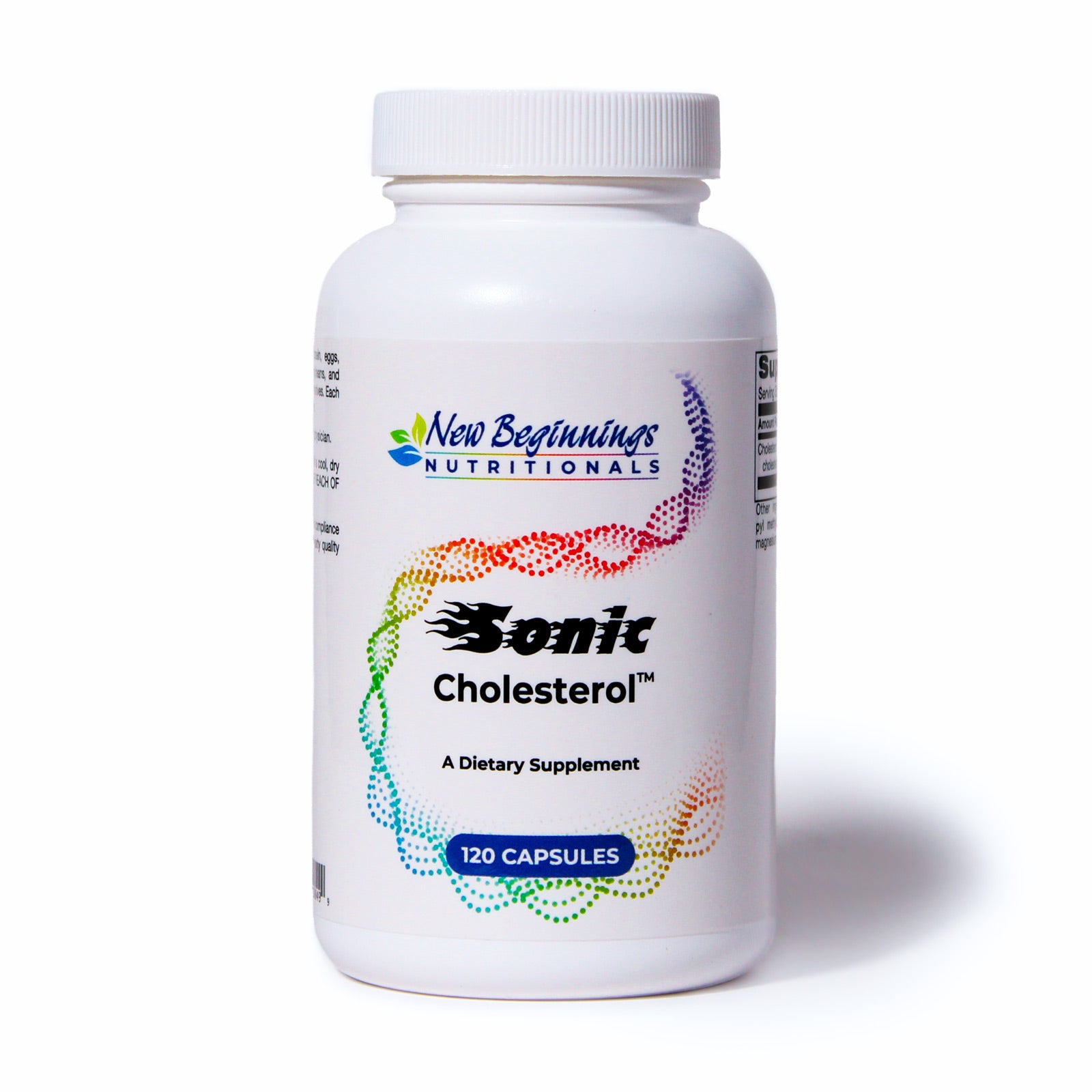
Highly purified cholesterol extracted from sheep wool was used to produce New Beginnings “Sonic” Cholesterol, which was made available in 250 mg capsules, the same amount of cholesterol found in a medium sized egg yolk. Egg yolks can be used as a source of cholesterol for those people who are significantly deficient in cholesterol. However, some patients may not like to eat eggs or are allergic to them. Testing total cholesterol does not require fasting which is needed for the measurement of triglycerides. For more information about Sonic Cholesterol and how to dose it, click here.
These statements have not been evaluated by the FDA. This product is not intended to diagnose, treat, cure, or prevent any disease.
References
-
The Dark Side of Statins. Duane Graveline MD, MPH. Published by Spacedoc Media, 2017.
-
Abnormalities of cholesterol metabolism in autism spectrum disorders. American Journal of Medical Genetics Part B: Neuropsychiatric Genetics. Vol 141B, Issue 6, Pages 666–668, 2006. Elaine Tierney et al.
-
Fleck CJ et al. Hypocholesterolemia (low cholesterol), hypertriglyceridemia, suicide, and suicide ideation in children hospitalized for psychiatric diseases. Pediatric Research. 1994 May;35(5):602–10.
-
Modai I. Serum cholesterol levels and suicidal tendencies in psychiatric inpatients. Journal of Clinical Psychiatry. 1994 Jun;55(6):252–4.
-
Buydens-Branchey L, Branchey M. Association between low plasma levels of cholesterol and relapse in cocaine addicts. Psychosomatic Medicine. 65:86–91 (2003).
-
Zhang J et al. Association of serum cholesterol and history of school suspension among school-age children and adolescents in the United States. American Journal of Epidemiology. 2005;161:691–699.